Maximize Your 2026 Retirement Benefits: Key 401(k) and IRA Changes

AD
Understanding the key changes to 401(k) and IRA contributions in 2026 is crucial for maximizing your retirement benefits, ensuring you can strategically adjust your savings to meet future financial goals.
As we approach 2026, understanding how to maximize your 2026 retirement benefits is more critical than ever. The financial landscape is constantly evolving, and with new adjustments to 401(k) and IRA contribution limits, proactive planning is essential for a secure future.
AD
Navigating 2026 401(k) Contribution Limits
The 401(k) remains a cornerstone of retirement planning for many Americans. For 2026, anticipate adjustments to the annual contribution limits, reflecting inflation and economic conditions. These changes directly impact how much you can set aside tax-deferred or tax-free, making it vital to stay informed.
Understanding these limits allows you to optimize your payroll deductions and potentially reduce your taxable income in the current year. Many employers also offer matching contributions, which can significantly boost your retirement nest egg if you contribute enough to qualify for the full match.
AD
Understanding the New Standard Limits
The Internal Revenue Service (IRS) typically announces these figures late in the preceding year, but financial advisors often project them based on economic indicators. These standard limits apply to most employees with traditional 401(k) plans.
- Increased Standard Limit: Expect an increase in the maximum employee contribution, allowing you to save more.
- Catch-Up Contributions: For those aged 50 and over, catch-up contributions will also see an adjustment, providing an additional opportunity to boost savings.
- Employer Contribution Limits: The total contribution limit, including both employee and employer contributions, will also be updated.
It is important to review your current contribution strategy against these new limits. Adjusting your contributions early in the year ensures you take full advantage of the updated allowances without rushing at year-end. This proactive approach can lead to substantial long-term gains in your retirement account.
These changes are designed to help individuals keep pace with rising costs and provide more robust savings opportunities. Consulting with a financial advisor can help you tailor your contributions to meet your specific financial goals and risk tolerance.
Decoding 2026 IRA Contribution Adjustments
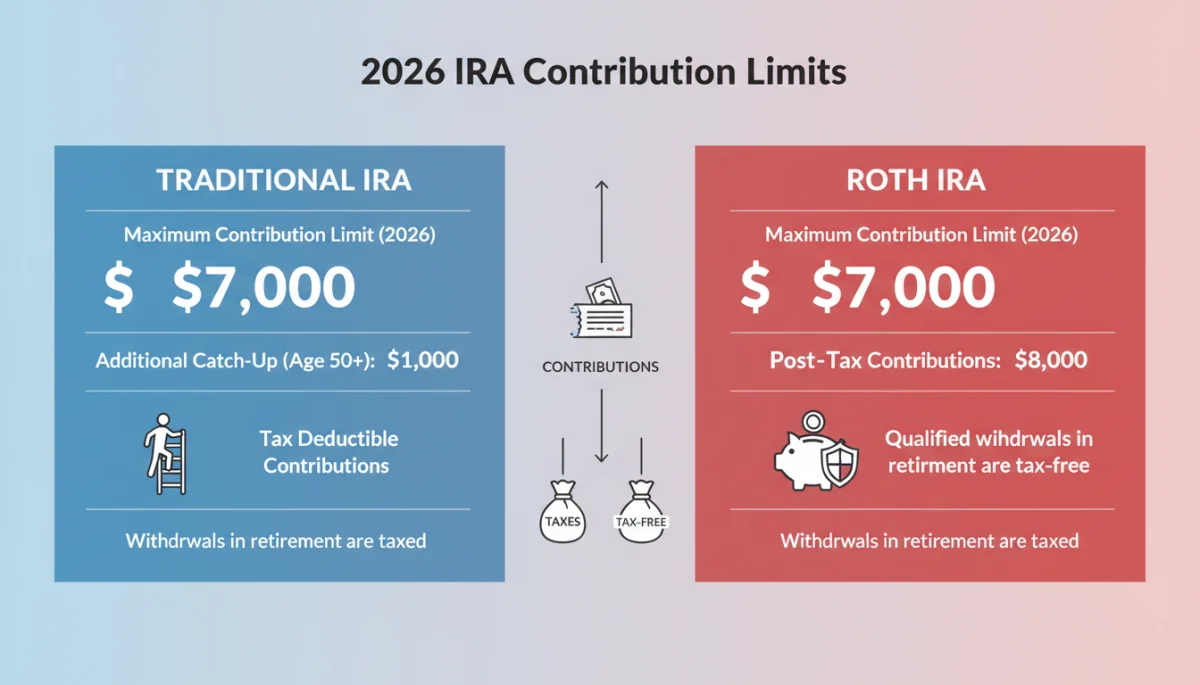
Individual Retirement Accounts (IRAs), including Traditional and Roth IRAs, offer flexible savings options outside of employer-sponsored plans. The 2026 adjustments to IRA contribution limits will influence how much you can contribute and the tax advantages you can leverage.
These limits are often influenced by inflation and economic forecasts, similar to 401(k)s. Knowing these figures will help you determine the most effective way to allocate your retirement savings across different account types, optimizing for both growth and tax efficiency.
Traditional vs. Roth IRA: What’s New?
Both Traditional and Roth IRAs will likely see an increase in their standard contribution limits. However, the income phase-out ranges for Roth IRA contributions and the deductibility of Traditional IRA contributions will also be updated, which is crucial for higher earners.
- Higher Contribution Ceiling: Both IRA types will likely allow for larger annual contributions.
- Roth IRA Income Thresholds: The income limits for contributing directly to a Roth IRA are expected to increase, potentially allowing more individuals to qualify.
- Traditional IRA Deductibility: Income phase-out ranges for deducting Traditional IRA contributions (especially if covered by a workplace retirement plan) will also be adjusted.
For many, the choice between a Traditional and Roth IRA hinges on current versus future tax expectations. With updated limits, re-evaluating which account best suits your financial situation is a smart move. Those expecting to be in a higher tax bracket in retirement might favor a Roth, while those seeking immediate tax deductions might lean towards a Traditional IRA.
Consider the broader implications of these changes on your overall financial strategy. Diversifying your retirement savings across different account types can provide greater flexibility and tax advantages in the long run. Professional guidance can help clarify which option is best for your personal circumstances.
Maximizing Catch-Up Contributions for Older Savers
For individuals aged 50 and older, catch-up contributions provide a critical opportunity to accelerate retirement savings. These additional contributions allow older workers to contribute more than the standard limits to both 401(k)s and IRAs, helping them make up for lost time or boost their savings as retirement approaches.
The rules around catch-up contributions are designed to acknowledge that many individuals may not have prioritized retirement savings earlier in their careers or may have experienced periods of lower income. These provisions offer a valuable second chance to bolster financial security.
Projected 2026 Catch-Up Limits
While specific figures are typically released later in the year, it’s reasonable to expect an increase in the catch-up contribution limits for 2026, reflecting ongoing inflation adjustments. These increases provide a significant advantage for those nearing retirement.
- 401(k) Catch-Up Increase: The additional amount allowed for 401(k)s will likely see an upward revision.
- IRA Catch-Up Boost: Similarly, the catch-up contribution for IRAs is also expected to increase.
- Strategic Planning: Utilize these higher limits to maximize your pre-tax or tax-free savings.
If you are eligible for catch-up contributions, it is highly advisable to take full advantage of them. Even small increases in annual contributions can lead to substantial growth over a few years, thanks to the power of compounding. This is especially true for those with a shorter time horizon until retirement.
Review your budget and consider if you can allocate additional funds to these catch-up provisions. Every dollar contributed now can significantly impact your financial comfort in retirement. Don’t underestimate the power of these extra contributions.
Strategic Planning for Optimal Retirement Savings
Beyond simply meeting contribution limits, strategic planning involves a holistic view of your financial situation. This includes assessing your risk tolerance, understanding your employer’s retirement plan details, and considering other investment vehicles.
Effective retirement planning is not a one-size-fits-all approach. It requires regular review and adjustments based on life changes, economic shifts, and evolving financial goals. Taking a comprehensive approach ensures you are building a robust and resilient retirement portfolio.
Diversifying Your Retirement Portfolio
While 401(k)s and IRAs are foundational, consider diversifying your savings with other investment options. This might include taxable brokerage accounts, health savings accounts (HSAs) with investment features, or even real estate.
- HSAs as Investment Vehicles: If eligible, HSAs offer a triple tax advantage: tax-deductible contributions, tax-free growth, and tax-free withdrawals for qualified medical expenses.
- Brokerage Accounts: For funds beyond retirement account limits, taxable brokerage accounts offer flexibility and access to a wider range of investments.
- Professional Guidance: A financial advisor can help you create a diversified portfolio tailored to your specific needs and retirement timeline.
Understanding the nuances of each investment type and how they fit into your overall strategy is crucial. Diversification helps mitigate risk and can enhance returns over the long term. Avoid putting all your eggs in one basket, especially when planning for something as critical as retirement.
Regularly rebalancing your portfolio to align with your risk tolerance and financial goals is also a key component of strategic planning. This ensures your investments remain on track to meet your retirement objectives, adapting to market conditions as needed.
Understanding the SECURE Act 2.0 Impact on 2026 Benefits
The SECURE Act 2.0, enacted in late 2022, introduced several significant changes that will continue to roll out and impact retirement planning through 2026 and beyond. These provisions aim to enhance retirement savings opportunities, particularly for small businesses and individuals.
These legislative changes are designed to make it easier for people to save for retirement, offering new incentives and expanding existing benefits. Staying current on these developments is essential for leveraging all available advantages.
Key Provisions Affecting 2026
Several aspects of SECURE Act 2.0 will become fully effective or see further implementation in 2026. These include changes to required minimum distributions (RMDs), employer matching for student loan payments, and expanded Roth options.
- RMD Age Increase: The age for required minimum distributions may see further adjustments, allowing savings to grow tax-deferred for longer.
- Student Loan Matching: Employers may be able to make matching contributions to retirement accounts for employees making qualified student loan payments.
- Rothification Opportunities: More options for Roth contributions within employer-sponsored plans, including potentially for employer matching contributions, could emerge.
These changes offer new avenues for saving and provide greater flexibility in managing your retirement funds. For instance, the student loan matching provision could be a game-changer for younger workers burdened by debt, allowing them to save for retirement without sacrificing loan payments.
It’s important to consult with your employer’s HR department or a financial professional to understand how these provisions specifically apply to your situation. Proactive engagement with these new rules can significantly improve your long-term financial outlook.
Proactive Steps to Optimize Your 2026 Retirement Plan
Optimizing your retirement plan for 2026 requires a proactive approach, starting with a thorough review of your current financial standing and future goals. This involves more than just adjusting contribution amounts; it’s about aligning your entire financial strategy with your retirement aspirations.
Taking proactive steps now can prevent last-minute scrambling and ensure you are positioned to fully benefit from all available opportunities. A well-thought-out plan provides peace of mind and a clear roadmap to financial independence.
Actionable Strategies for the Coming Year
Start by reviewing your budget to identify areas where you can increase your savings. Consider automating your contributions to ensure consistency, and regularly check your investment performance against your goals.
- Review and Adjust Contributions: As soon as the 2026 limits are confirmed, adjust your 401(k) and IRA contributions to the new maximums if feasible.
- Rebalance Your Portfolio: Periodically review your investment allocation to ensure it aligns with your risk tolerance and time horizon.
- Consult a Financial Advisor: Seek professional advice to create a personalized retirement strategy that accounts for all 2026 changes and your individual circumstances.
Don’t wait until the end of 2026 to make these adjustments. Early action allows your money more time to grow, taking full advantage of compounding returns. Even small, consistent increases in contributions can lead to significant differences over time.
By taking these proactive steps, you can confidently navigate the changes in 2026 and ensure your retirement savings are on the strongest possible path. A well-informed and strategic approach is your best ally in achieving a secure and comfortable future.
| Key Aspect | 2026 Impact |
|---|---|
| 401(k) Limits | Expected increase in standard and catch-up contributions due to inflation adjustments. |
| IRA Limits | Anticipated higher contribution limits for Traditional and Roth IRAs, with adjusted income phase-outs. |
| SECURE Act 2.0 | Further implementation of RMD age changes, student loan matching, and expanded Roth options. |
| Strategic Planning | Reviewing budgets, automating contributions, and diversifying portfolios are key for optimal savings. |
Frequently Asked Questions About 2026 Retirement Benefits
While the official IRS limits for 2026 are typically announced late in 2025, economic forecasts suggest an increase in both standard and catch-up contributions for 401(k) plans, reflecting inflation adjustments. It’s crucial to monitor official IRS publications for the definitive figures as they become available.
Similar to 401(k)s, IRA contribution limits for 2026 are expected to rise for both Traditional and Roth accounts. Additionally, the income phase-out ranges for Roth IRA eligibility and Traditional IRA deductibility are likely to be adjusted, impacting eligibility for certain tax benefits.
SECURE Act 2.0 introduces several provisions that will continue to roll out into 2026. Key impacts include potential changes to Required Minimum Distribution (RMD) ages, new rules allowing employers to match student loan payments, and expanded options for Roth contributions within workplace plans, offering more flexibility for savers.
Prioritizing depends on your individual circumstances. Generally, it’s wise to contribute enough to your 401(k) to get the full employer match, as this is free money. After that, consider maximizing an IRA (Traditional or Roth, based on your tax situation) before contributing more to your 401(k) up to its limit. Consulting a financial advisor is recommended.
For those aged 50 and over, catch-up contribution limits for both 401(k)s and IRAs are expected to increase in 2026. The main strategy remains to fully utilize these higher limits to accelerate savings as retirement approaches. Review your budget to see if you can increase your contributions to take full advantage of these provisions.
Conclusion
The year 2026 presents both challenges and opportunities for retirement savers. With anticipated adjustments to 401(k) and IRA contribution limits, alongside the continued implementation of SECURE Act 2.0 provisions, proactive and informed planning is paramount. By understanding these key changes, leveraging catch-up contributions, and adopting a strategic approach to diversification, individuals can significantly enhance their retirement security. Staying engaged with financial news and consulting with professionals will empower you to maximize your benefits and secure a comfortable future.
